

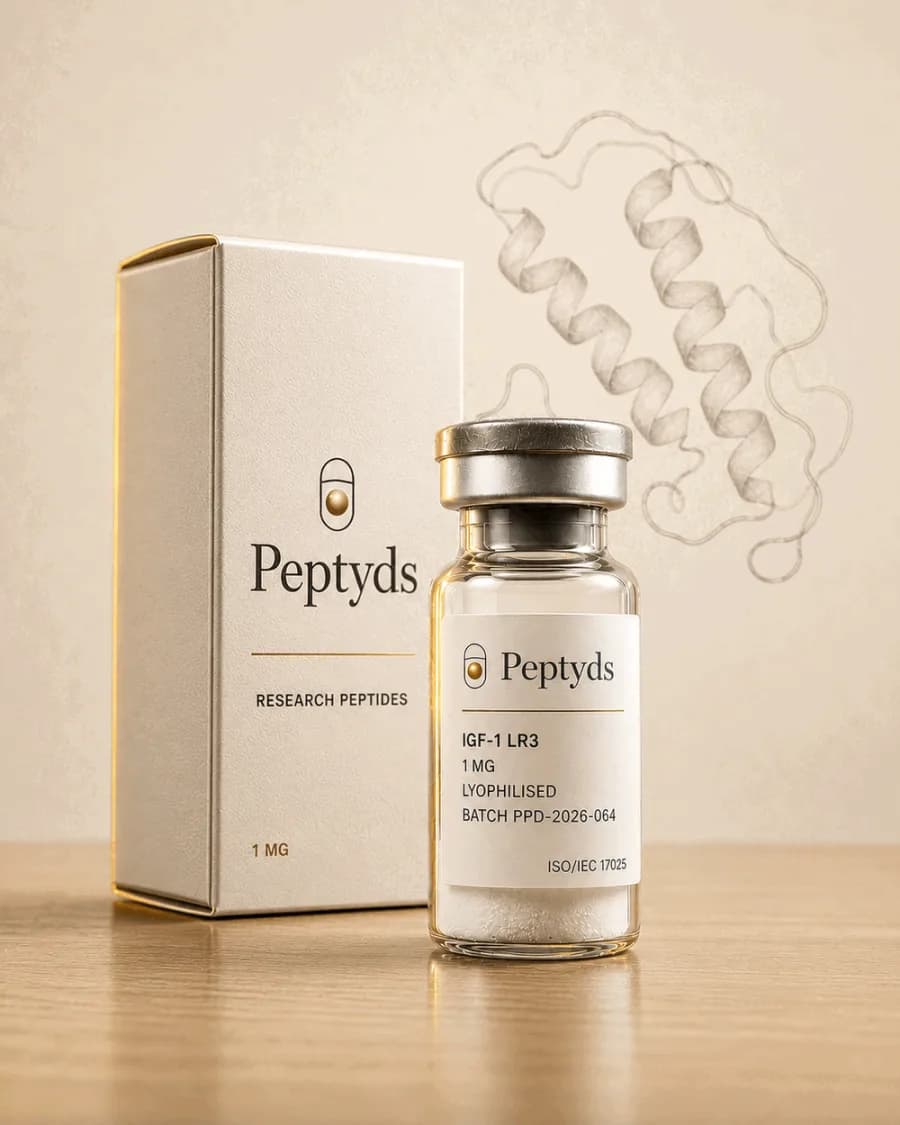
IGF-1 LR3
IGF-1 LR3 is a modified recombinant insulin-like growth factor 1 analogue of 83 amino acids synthesised with an N-terminal extension and Arg3 substitution, studied in anabolic signalling research for its role in increasing the free fraction of circulating IGF-1 (~3× vs native).
A long-acting IGF-1 analogue studied for anabolic signalling and measured body-composition support — framed for clinician-guided recovery protocols.
For Research Use Only — Not for Human Consumption.
Sold strictly for in vitro laboratory research purposes.
Listed under the WADA 2026 Prohibited List.
Not for use by competitive athletes in sanctioned sports.
In stock now
IGF-1 LR3 is out of stock. These are in stock.
Different compounds, matched on shared research goal and comparable cost per mg. They are not substitutes for one another — read the research on each page before you order.
Why it is not stocked
The 1 mg IGF-1 LR3 vial is out of stock. The pharmacology, research notes and FAQ on this page stay published as the compound reference.
- CJC-1295 No DAC + IpamorelinDual-Pathway Growth Hormone ResearchSame goal · €7.50 / mgfrom €75
- IpamorelinSelective Growth Hormone ResearchSame goal · €4.40 / mgfrom €44
- TesamorelinPituitary Growth Hormone ResearchSame goal · €6.90 / mgfrom €69
Email me when this batch returns
- Availability
- Delivered in 3–7 days (EU)
- Storage
- Store 2–8 °C. Use reconstituted vial within 14 days.
- Ships from
- European fulfilment centre, tracked express
Lab proof, by batch
- Tested independently, by batch
- Certificate of analysis available
- Purity and identity on record
Anabolic Protein Synthesis Research.
IGF-1 LR3 (Long R3 IGF-1, CAS 946870-92-4) is a recombinant 83-amino-acid analogue of insulin-like growth factor 1 with a 13-amino-acid N-terminal extension and an Arg3 substitution that sharply reduce binding to IGF-binding proteins. Research has examined anabolic signalling, muscle-protein synthesis, and connective-tissue response. Formula C400H625N111O115S9, MW 9111.04 g/mol.
- — Tomas et al. — Long R3 IGF-1 bioactivity and reduced IGFBP affinity
- — Bach et al. — IGF-1 analogue signalling in skeletal muscle protein synthesis
Research context only. Not medical advice. Not for human or veterinary use.
- 1 mg lyophilised powder per vial
- Reconstitute with bacteriostatic water before use
- Store lyophilised at 2–8 °C, keep from light
- Once reconstituted, refrigerate and use within 14 days
- One 1 mg lyophilised IGF-1 LR3 vial
- Tamper-evident cap with batch-coded label
- Storage and clinician-consultation card
What the research reports about this molecule.
Classic parameters from peer-reviewed literature. Not human dosing guidance — read alongside the PubMed references on /learn.
- Sequence
- Modified IGF-1 (N-terminal extension + Arg3 substitution)
- Molecular weight
- 9120 Da
- Mechanism
- ~3× free fraction vs native IGF-1; anabolic signalling
- Research domain
- Anabolic signalling
- Reconstitution
- Bacteriostatic water, USP
- Storage
- Long-term -20°C lyophilised; -80°C for >12 months; reconstituted 2-8°C, ≤4 weeks
From arrival to storage.
Laboratory handling notes for this compound. Peptyds products are supplied for research use only, not for human or veterinary use, so we give no dosing or administration guidance.
- 1
Store the sealed vial at 2–8 °C, away from light
- 2
Reconstitute with bacteriostatic water — swirl, do not shake
- 3
Label the vial with its batch number and reconstitution date
- 4
Refrigerate reconstituted vial; use within 14 days
Handling guide
Read the reconstitution guide
Reconstitution and storage for laboratory handling, step by step.
Reconstitution calculator
Research use onlySyringe
Peptide in vial
Bacteriostatic water
Concentration0.5 mg/mL
Target dose
Pull syringe to
50
units · 0.5 mL
Concentration
0.5
mg/mL
Doses per vial
4
doses
U-50 25 · U-40 20 units
For laboratory research calculation only. Not medical or dosing advice, and not for human or veterinary use.
Others researching Recovery also compare
- IGF-1 LR3This pageSizes: 1 mgPrice / mg: €89.00 / mg
- BPC-157 ComplexSizes: 5 mg · 10 mgPrice / mg: €4.90 / mg
- TB-500Sizes: 5 mg · 10 mgPrice / mg: €8.90 / mg
- RetatrutideSizes: 10 mg · 60 mgPrice / mg: €4.32 / mg
Each release is matched with quality documentation through a documented verification path. Identity, purity, and composition test results sit on the product page before you buy.
Every batch is verified by an ISO/IEC 17025-accredited laboratory before release. Identity, purity, and documentation travel with the product — not behind a form.
Sensitive peptides ship in insulated cold packaging with gel packs sized for a 48-hour transit window, tracked door to door.
Everything worth asking before you order.
Shipping, storage, quality, and when to speak to a clinician — without the runaround.
What proof of quality comes with my order?
Every batch ships with a batch code printed on the vial. The matching independent lab report — showing identity, purity, and composition — is linked on the product page and stays on your order page after purchase.
Should I speak to a clinician before using a peptide?
We recommend it — especially if you are pregnant, nursing, managing a medical condition, or combining peptides with prescribed medication. Our product pages are educational. They are not medical advice and they do not replace a conversation with a qualified practitioner.
How should I store my order when it arrives?
Sensitive peptides ship cold. Move them to a fridge on arrival (2–8 °C) unless the product page states otherwise. Lyophilised vials can tolerate short transit at ambient temperature but should not be left unrefrigerated for extended periods once delivered.
Are research peptides banned by WADA?
Several research peptides we list — including BPC-157, TB-500, GHRPs, and IGF-1 LR3 — are listed on the WADA Prohibited List under classes S0 (unapproved substances) and S2 (peptide hormones and growth factors). They are prohibited at all times, in and out of competition.
How do I reconstitute a lyophilised peptide vial?
Bring both the lyophilised vial and the bacteriostatic water to room temperature, equalise pressure with a sterile vented needle, then inject the solvent slowly down the side of the vial. Swirl gently — never shake — until clear, and refrigerate at 2–8 °C.
How much bacteriostatic water should I add to my peptide vial?
The calculation is peptide mass (mg) ÷ desired concentration (mg/mL) = volume of bacteriostatic water in mL. For example, a 5 mg vial at 1 mg/mL needs 5 mL; at 2 mg/mL, 2.5 mL. Every Peptyds product page carries a suggested reconstitution volume tuned to the vial size.
How long does a reconstituted peptide stay stable in the fridge?
Most lyophilised peptides reconstituted with bacteriostatic water remain stable for 28–30 days at 2–8 °C, protected from light. A handful of short, fragile sequences — Epithalon among them — drop to roughly 14 days. Never freeze a reconstituted vial.
What side effects are most commonly reported across peptide research?
Across published trials and case series, the most frequent reported events are injection-site reactions (redness, induration, transient discomfort), headache, mild nausea, and temporary fatigue. GLP-1 and dual-agonist class peptides add dose-dependent gastrointestinal effects.
Who should not use peptides?
Peptides are not appropriate for anyone who is pregnant, nursing, planning conception, under 18, managing active cancer, or on immunosuppressants — and competitive athletes governed by WADA must avoid every peptide on the prohibited list. Anyone with a personal or family history of melanoma should specifically avoid melanocortin-receptor agonists.