

Sexual-health peptides are short signaling molecules studied for central nervous system melanocortin pathways and sexual desire and arousal research.
Sexual Health
All products listed under this goal are supplied for in vitro laboratory research only and are not intended for human consumption or therapeutic use.
Peptides for intimacy and confidence — chosen with care.
Peptides chosen with discretion and care — each with visible testing, clear science, and respectful delivery.
- How is my order packaged and delivered?
- What testing do these peptides go through?
- Where can I read the research before buying?
A short list of peptides that fit this goal.
We keep the choice focused. Every peptide here has a clear purpose, ISO/IEC 17025 lab testing, and a product page written without jargon.
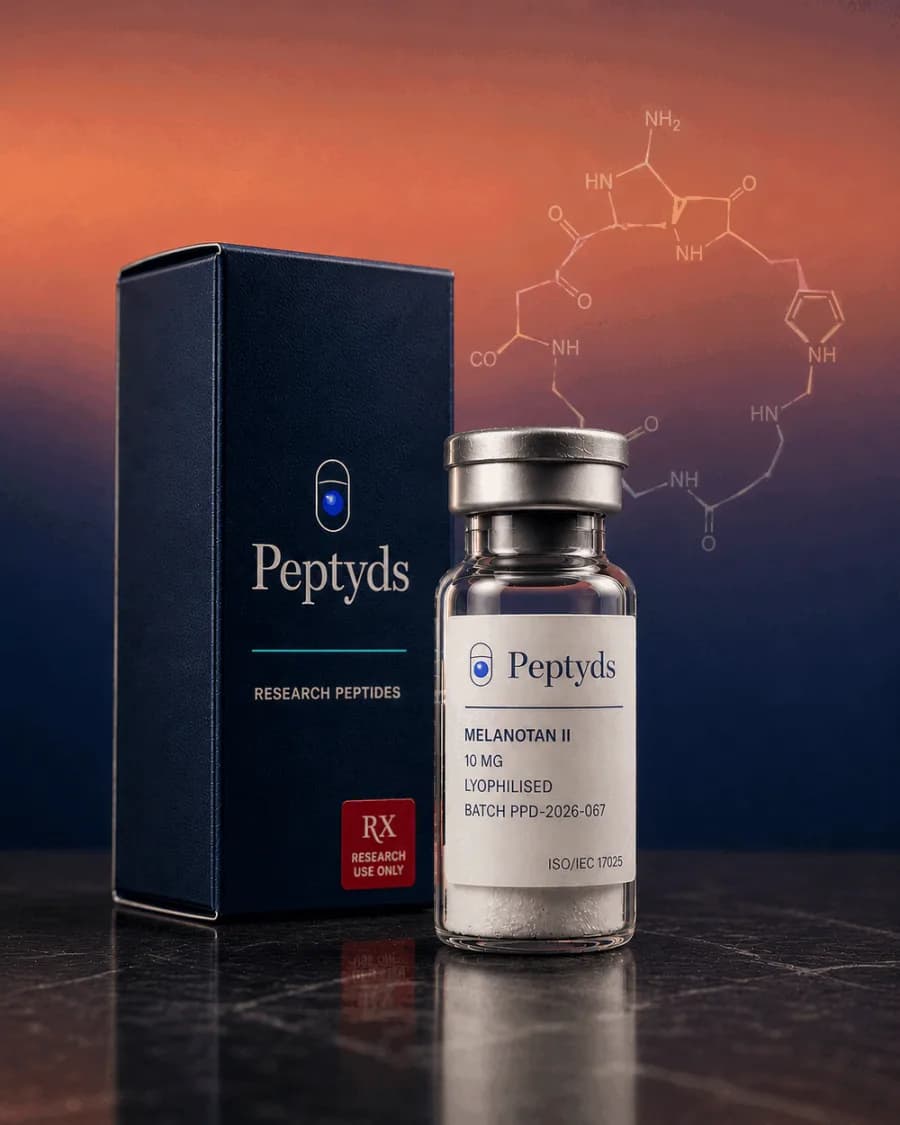
A melanocortin receptor agonist studied for its effects on melanogenesis, sexual function, and appetite regulation through MC1R–MC4R pathway activation.
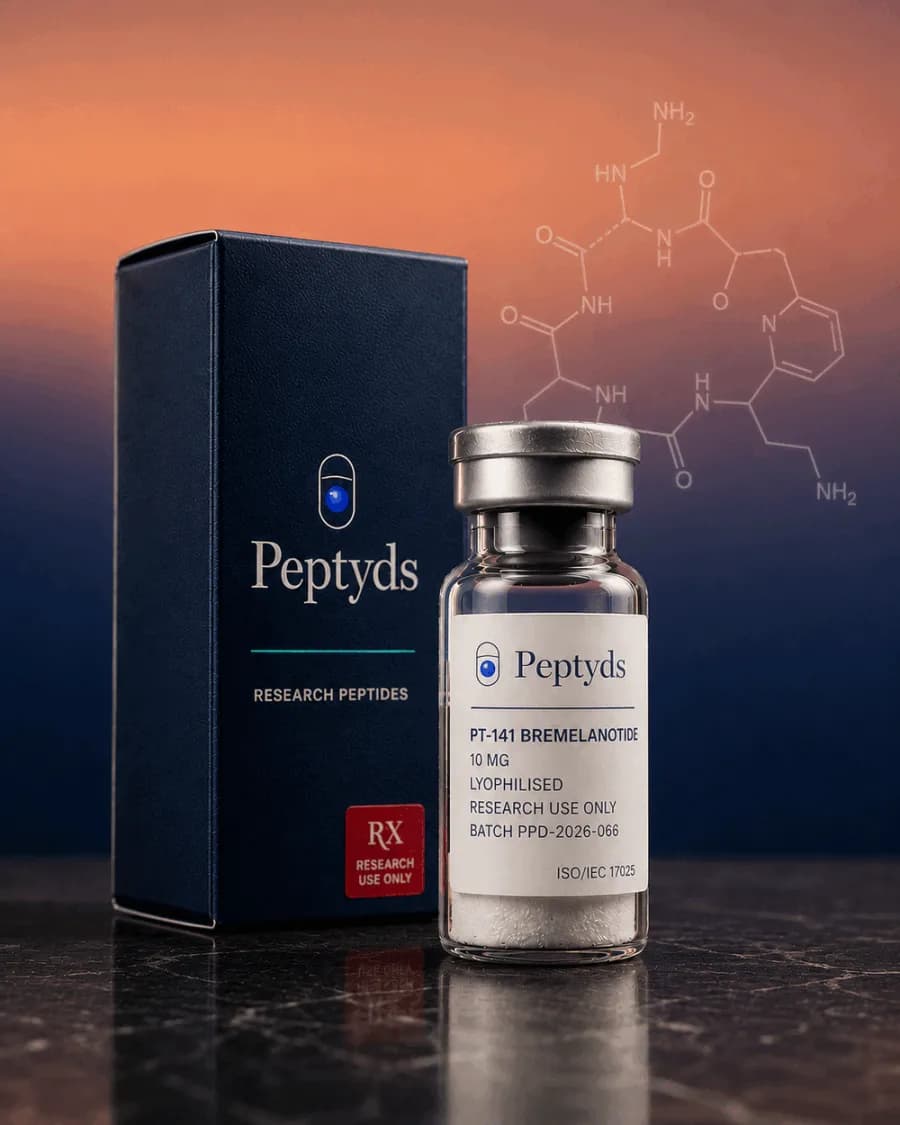
Bremelanotide — a melanocortin receptor agonist studied for its role in sexual arousal pathways through central nervous system signalling rather than vascular mechanisms.
- confidence-led-copy
- trust-cues
Each release is matched with quality documentation through a documented verification path. Identity, purity, and composition test results sit on the product page before you buy.
Every batch is verified by an ISO/IEC 17025-accredited laboratory before release. Identity, purity, and documentation travel with the product — not behind a form.
The numbering suggests a sequel. The pharmacology says otherwise: one binds narrowly, the other binds across a receptor family that governs far more than pigmentation.
PT-141 and Melanotan II share a chemical family but split completely on regulatory approval and safety. The mole-and-melanoma question is not optional reading.
PT-141 is one of the few research peptides with a phase 3 programme and an FDA label behind it. That label is also the most detailed public record of what the molecule does wrong, and it deserves to be read first.
Kisspeptin is the peptide hormone family — kisspeptin-54, -14, -13 and -10 — that sits upstream of the entire human reproductive axis, acting through the KISS1R receptor to trigger GnRH release. This is what the published human research actually shows, from IVF trigger trials to brain-imaging studies, and where the evidence stops.
Questions people ask about this category.
Honest, short answers to the things most shoppers want to know before they buy.
Research-only means the compound has not been approved by the EMA or any national medicines authority for medical use, and is sold solely for in-vitro and laboratory research. It is not a supplement, a cosmetic, or a medicine, and it carries no claims for human consumption.
PT-141 (bremelanotide) is a melanocortin-receptor agonist that acts centrally on MC3R and MC4R pathways in the hypothalamus, modulating sexual arousal signalling. PDE-5 inhibitors such as sildenafil act peripherally on vascular smooth muscle. Bremelanotide is FDA-approved as Vyleesi for hypoactive sexual desire disorder in premenopausal women; in the EU it is not approved.
Published pharmacokinetic studies report a plasma half-life of roughly 2.7 hours for bremelanotide, with measurable receptor effects in clinical trials spanning approximately 6–12 hours after a single subcutaneous dose.
A prescription peptide (e.g. Wegovy, Mounjaro, Vyleesi, Zadaxin in the relevant jurisdictions) has been through EMA or national-authority review, carries an authorised indication, and is dispensed by a pharmacy against a script. A research peptide is a reference-grade compound sold for laboratory use only.
Bring both the lyophilised vial and the bacteriostatic water to room temperature, equalise pressure with a sterile vented needle, then inject the solvent slowly down the side of the vial. Swirl gently — never shake — until clear, and refrigerate at 2–8 °C.