

Science

Melanotan I vs Melanotan II: Selective Binding Against Broad, and What That Predicts

Melanotan I (afamelanotide) is an alpha-MSH analogue with relative selectivity for the melanocortin-1 receptor, the receptor governing melanogenesis. Melanotan II is a non-selective analogue active across MC1R, MC3R, MC4R and MC5R, which is why its reported effects extend beyond pigmentation into appetite and sexual function. That breadth is also why Melanotan II carries explicit safety warnings from the MHRA and TGA, and why PT-141 was developed from it by narrowing the receptor profile back down.

7 min readUpdated 28 Aug 2026Reviewed by Independent EU laboratory (ISO/IEC 17025)
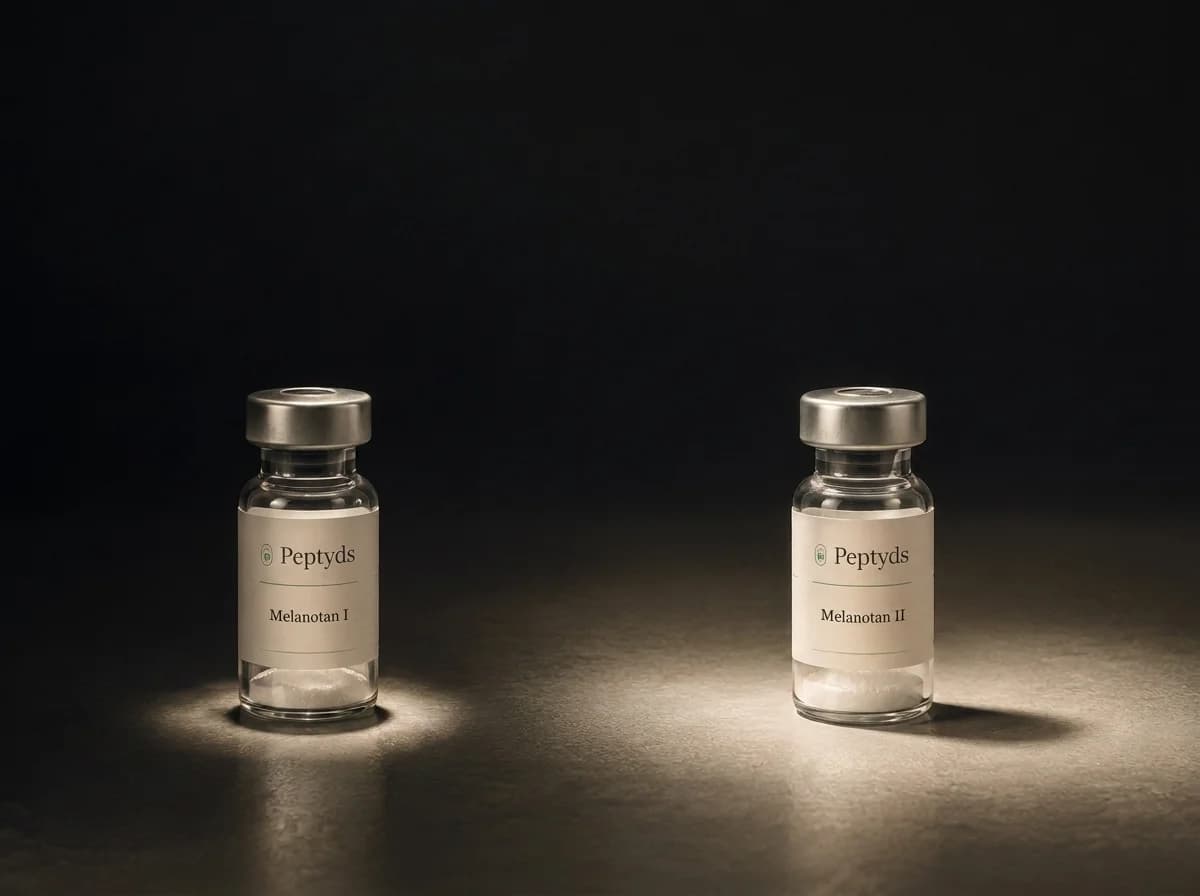
Two Peptyds research vials labelled Melanotan I and Melanotan II standing apart on a dark stone surface, each in its own pool of warm light
Jump to section
  1. 01The numbering is misleading
  2. 02What the extra receptors do
  3. 03The regulatory record is not neutral
  4. 04Handling, which is the same for both
  • Melanotan I binds MC1R with relative selectivity. Melanotan II binds across MC1R, MC3R, MC4R and MC5R.
  • The extra receptors are why Melanotan II reports effects on appetite and sexual function that Melanotan I largely does not.
  • Both the MHRA and the TGA have issued public warnings about unlicensed Melanotan II supply.
  • PT-141, a related peptide that is itself non-selective, was developed for a sexual-desire indication rather than for tanning.
  • Neither is a tanning product, a cosmetic, or a substitute for sun protection.

The compounds compared here

  • Melanotan IMelanogenesis & Photoprotection Research.10 mg€3.90 / mg
  • Melanotan IIA melanocortin receptor agonist studied for its effects on melanogenesis, sexual function, and appetite regulation through MC1R–MC4R pathway activation.10 mg€3.90 / mgOut of stock

The numbering is misleading

Both descend from alpha-melanocyte-stimulating hormone, the endogenous peptide that drives melanogenesis. Melanotan I — afamelanotide — is a linear analogue with relative selectivity for the melanocortin-1 receptor, the receptor that governs pigment production.[1]

Melanotan II is a cyclic analogue that binds across the melanocortin family: MC1R, MC3R, MC4R and MC5R. It is not a refined version of Melanotan I. It is a broader one, and the breadth is the entire story.[1][2]

Continue reading:PT-141 vials with batch report

What the extra receptors do

MC4R is centrally involved in appetite regulation and in sexual arousal pathways. MC3R contributes to energy homeostasis. Binding them is why Melanotan II reports effects — appetite suppression, spontaneous erections, nausea — that a compound acting mainly on MC1R does not produce.[1][2]

PT-141 took the same chemistry in a different direction. Bremelanotide, a related cyclic peptide, is also non-selective across melanocortin receptor subtypes, with MC4R the most relevant at therapeutic doses; it was developed for a central sexual-desire indication rather than for pigmentation.[6][1]

Continue reading:PT-141 vs Melanotan II

The regulatory record is not neutral

Melanotan II has drawn explicit public warnings from national regulators. The MHRA in the United Kingdom and the TGA in Australia have both issued statements about unlicensed supply, citing the absence of safety evaluation and the risks of unregulated injectable products sold for cosmetic purposes.[4][5]

Separately, the literature includes case reports of changes in melanocytic naevi following Melanotan use. The causal picture is not settled, but a compound that stimulates melanocytes and is used without dermatological oversight is not a neutral proposition.[3][2]

Handling, which is the same for both

Both arrive lyophilised, both require reconstitution with bacteriostatic water, and both need the reconstituted vial refrigerated and used within its working window. Neither tolerates repeated freeze-thaw cycles.[7][8]

Sources

  1. [01]
  2. [02]
  3. [03]
  4. [04]
  5. [05]
  6. [06]
  7. [07]
  8. [08]

Questions

What is the actual difference between Melanotan 1 and 2?

Receptor selectivity. Melanotan I acts with relative selectivity at MC1R, the pigmentation receptor. Melanotan II acts across MC1R, MC3R, MC4R and MC5R, which is why it reports effects on appetite and sexual function that Melanotan I largely does not.[1][2]

Is Melanotan II just a stronger version of Melanotan I?

No. It is a broader one, not a stronger one. The additional effects come from binding additional receptors, not from greater potency at the same receptor.[1]

Why was PT-141 developed from Melanotan II?

For a different purpose: central effects on sexual desire rather than pigmentation. Bremelanotide is itself non-selective across melanocortin receptor subtypes, with MC4R the most relevant at therapeutic doses, so its history reads as a change of indication rather than a narrowing of receptor binding.[6]

Have regulators said anything about these?

Yes. The MHRA and the TGA have both issued public warnings about unlicensed Melanotan II supply, citing absent safety evaluation and the risks of unregulated injectables sold for cosmetic use.[4][5]

Educational content. Not medical advice.

Next step

Choose the route that matches how you read.