

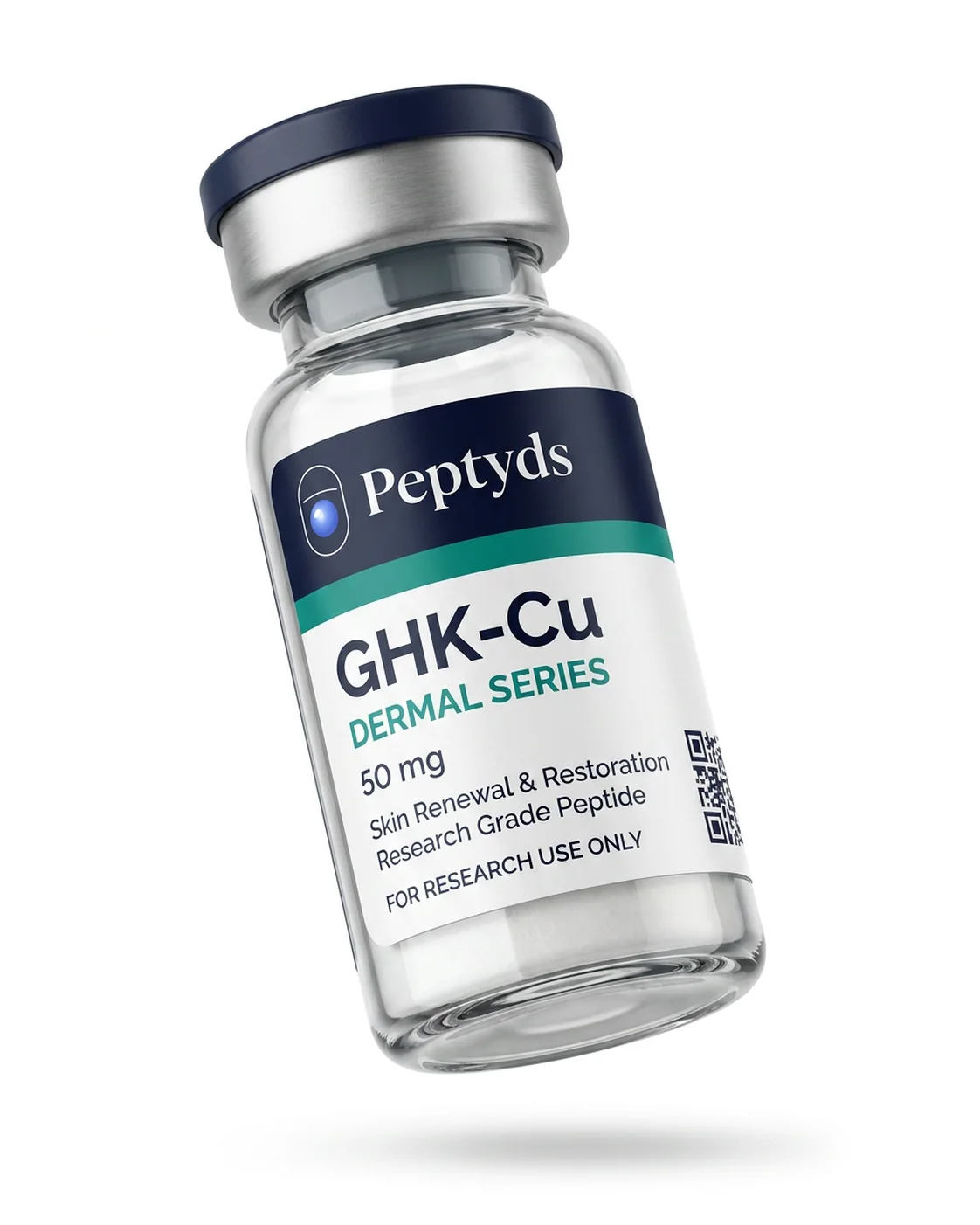
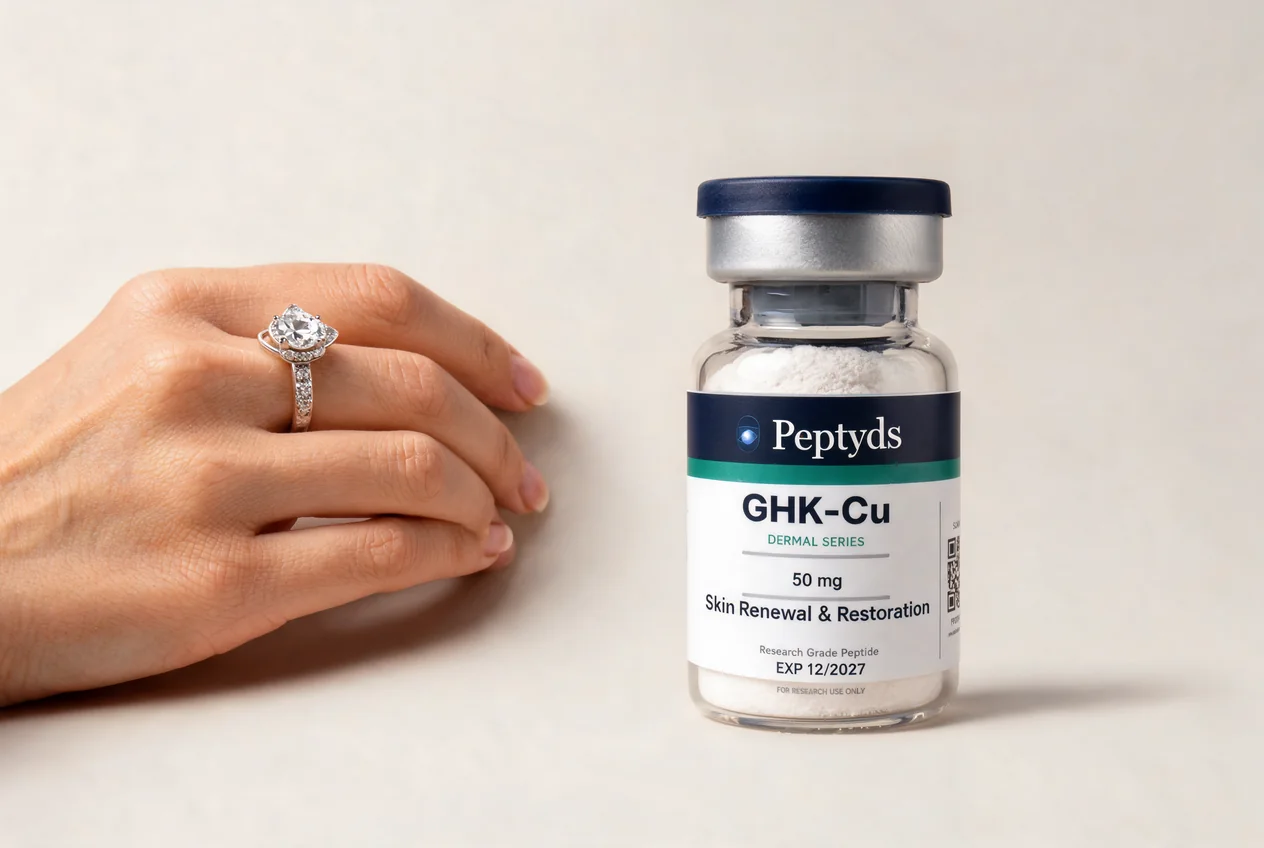
GHK-Cu
GHK-Cu is a naturally occurring tripeptide-copper complex of 3 amino acids (Gly-His-Lys) synthesised as a copper-coordinated peptide, studied in dermatology for its role in modulating collagen synthesis and dermal stem-cell signalling.
A copper-peptide complex studied for skin barrier support, collagen signalling, and visible texture renewal.
For Research Use Only — Not for Human Consumption.
Sold strictly for in vitro laboratory research purposes.
- Storage
- Store 2–8 °C. Reconstitute before use.
Up closeSkin & Anti-Aging
GHK-Cu
Renewal Systems
Dermal Remodelling & Synthesis Research.
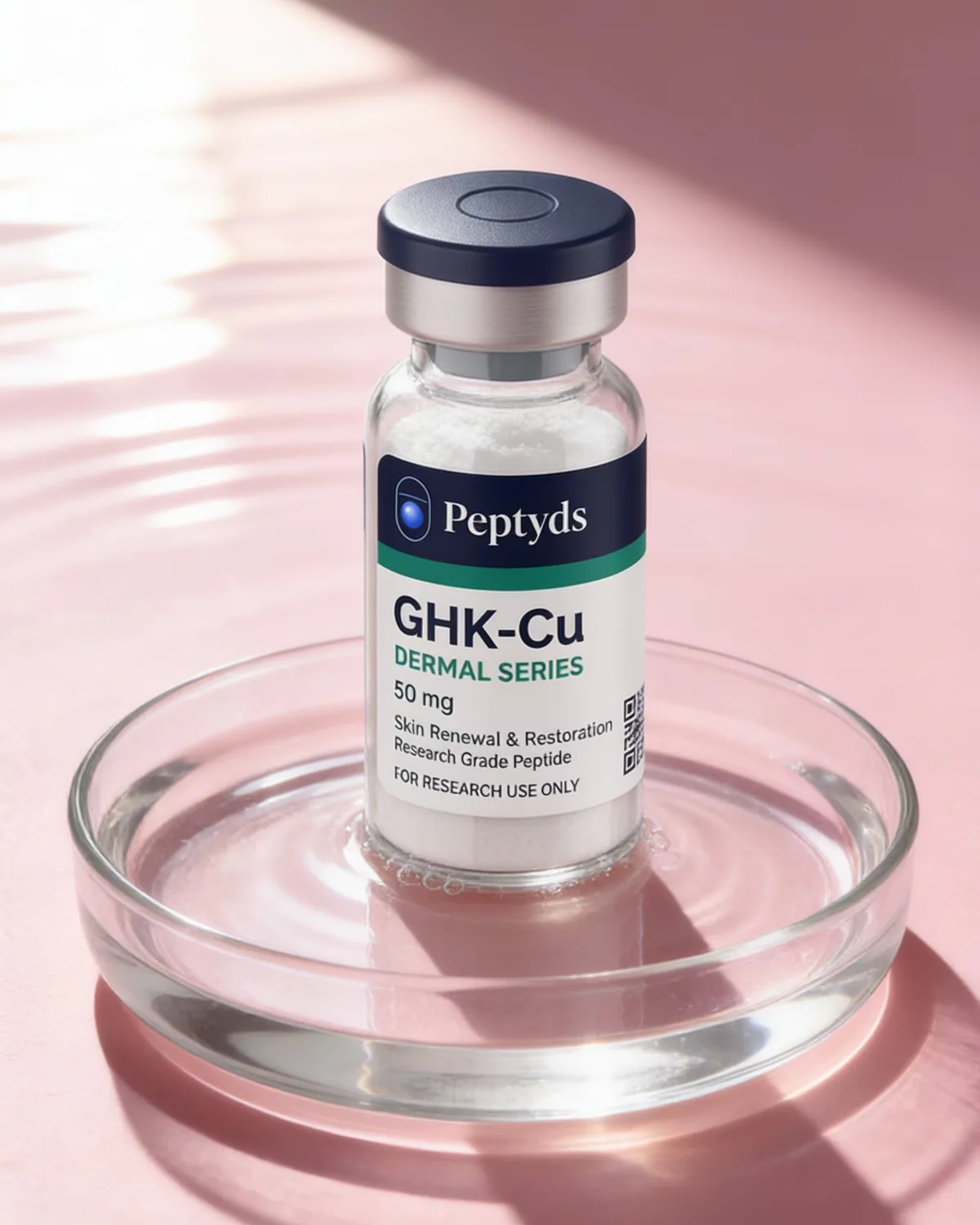
GHK-Cu is a naturally occurring tripeptide-copper complex studied for its role in extracellular matrix remodelling, wound-response signalling, and antioxidant activity in skin. Research-grade lyophilised powder for reconstitution.
- — Pickart et al. — GHK-Cu and extracellular matrix remodelling
- — Gruchlik et al. — copper-peptide effects on dermal fibroblasts
Research context only. Not medical advice. Not for human or veterinary use.
- Available in 10 mg, 20 mg, and 50 mg lyophilised powder per vial
- Reconstitute with bacteriostatic water before use
- Store lyophilised at 2–8 °C, keep from light
- Once reconstituted, refrigerate and use within 30 days
- One vial in the selected size
- Tamper-evident cap with batch-coded label
- Storage card with reconstitution guidance
What the research reports about this molecule.
Classic parameters from peer-reviewed literature. Not human dosing guidance — read alongside the PubMed references on /learn.
- Sequence
- Tripeptide-copper complex (Gly-His-Lys)
- Molecular weight
- 340 Da (peptide)
- Mechanism
- Modulates collagen synthesis and dermal stem-cell signalling
- Research domain
- Dermatology
- Storage
- Sealed: 2–8 °C, away from light; reconstituted: 2–8 °C, use within 30 days
From arrival to storage.
Laboratory handling notes for this compound. Peptyds products are supplied for research use only, not for human or veterinary use, so we give no dosing or administration guidance.
- 1
Store the sealed vial at 2–8 °C, away from light
- 2
Reconstitute with 2 mL bacteriostatic water — swirl gently, do not shake
- 3
Label the vial with its batch number and reconstitution date
- 4
Refrigerate reconstituted vial; use within 30 days
Handling guide
Read the reconstitution guide
Reconstitution and storage for laboratory handling, step by step.
Reconstitution calculator
Research use onlySyringe
Peptide in vial
Bacteriostatic water
Concentration25 mg/mL
Target dose
Pull syringe to
1
units · 0.01 mL
Concentration
25
mg/mL
Doses per vial
200
doses
U-50 0.5 · U-40 0.4 units
For laboratory research calculation only. Not medical or dosing advice, and not for human or veterinary use.
Others researching Skin & Anti-Aging also compare
- GHK-CuThis pageSizes: 50 mgPrice / mg: €0.78 / mg
- Melanotan ISizes: 10 mgPrice / mg: €3.90 / mg
Everything worth asking before you order.
Shipping, storage, quality, and when to speak to a clinician — without the runaround.
Where can I find product information?
Product pages contain product details and research information. Contact us if you have a question about an item.
How should I store my order when it arrives?
Follow the storage and handling guidance on the specific product page.
What happens after I place an order?
You will receive an order confirmation and, when your parcel is dispatched, a tracking update.
How do I reconstitute a lyophilised peptide vial?
Bring both the lyophilised vial and the bacteriostatic water to room temperature, equalise pressure with a sterile vented needle, then inject the solvent slowly down the side of the vial. Swirl gently — never shake — until clear, and refrigerate at 2–8 °C.
How much bacteriostatic water should I add to my peptide vial?
The calculation is peptide mass (mg) ÷ desired concentration (mg/mL) = volume of bacteriostatic water in mL. For example, a 5 mg vial at 1 mg/mL needs 5 mL; at 2 mg/mL, 2.5 mL. Every Peptyds product page carries a suggested reconstitution volume tuned to the vial size.
How long does a reconstituted peptide stay stable in the fridge?
Most lyophilised peptides reconstituted with bacteriostatic water remain stable for 28–30 days at 2–8 °C, protected from light. A handful of short, fragile sequences — Epithalon among them — drop to roughly 14 days. Never freeze a reconstituted vial.
What side effects are most commonly reported across peptide research?
Across published trials and case series, the most frequent reported events are injection-site reactions (redness, induration, transient discomfort), headache, mild nausea, and temporary fatigue. GLP-1 and dual-agonist class peptides add dose-dependent gastrointestinal effects.
Who should not use peptides?
Peptides are not appropriate for anyone who is pregnant, nursing, planning conception, under 18, managing active cancer, or on immunosuppressants — and competitive athletes governed by WADA must avoid every peptide on the prohibited list. Anyone with a personal or family history of melanoma should specifically avoid melanocortin-receptor agonists.