

Quality

How to Reconstitute Peptides: Concentration Math, Aliquoting, Shelf Life

Reconstitution is the procedure of dissolving a sterile lyophilised (freeze-dried) peptide powder in bacteriostatic water to produce a solution of known concentration for laboratory research. The core variables are: volume of bacteriostatic water added (which sets the final concentration in mg/mL), measurement technique (a calibrated pipette rather than an estimate by eye), reconstitution technique (room-temperature equilibration, slow addition down the vial wall, gentle swirl rather than shake), and post-reconstitution handling (dividing the solution into single-use aliquots, then storing at 2-8 °C protected from light; shelf-life in solution is much shorter than for the dry powder, and repeated freeze-thaw cycles should be avoided). Bacteriostatic water is sterile water with 0.9% benzyl alcohol as an antimicrobial preservative, suitable for a vial that is reused across multiple sessions. Plain sterile water has no preservative and is for single-use only.

11 min readUpdated 26 Sept 2026Reviewed by Independent EU laboratory (ISO/IEC 17025)
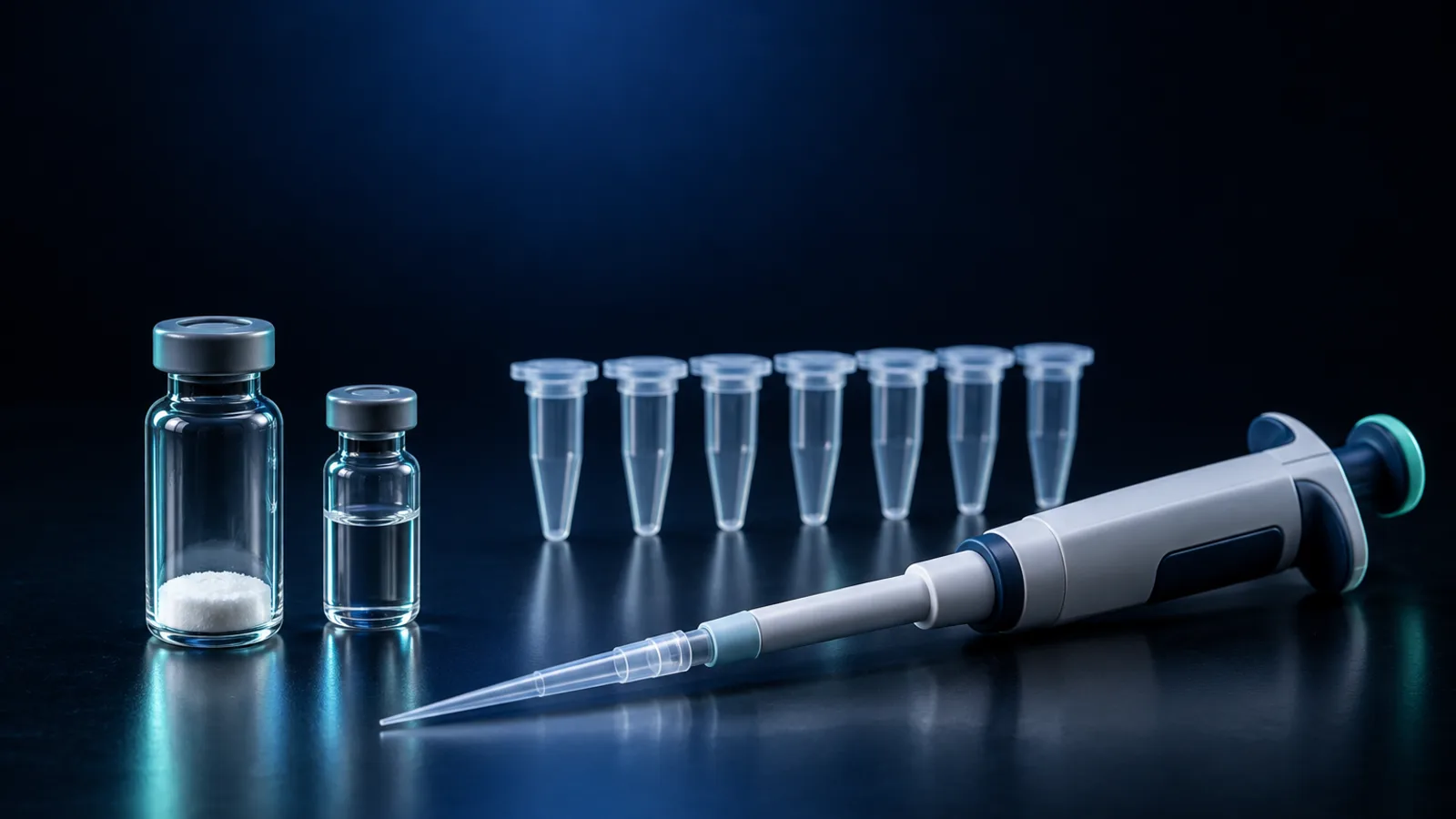
Two unlabelled glass vials, seven empty microcentrifuge tubes, and a laboratory pipette arranged on a dark reflective surface.
Jump to section
  1. 01What reconstitution actually is
  2. 02Equipment: what you need on the bench
  3. 03The math: mg ÷ mL = mg/mL final concentration
  4. 04Measuring accurately and dividing into aliquots
  5. 05Technique: equilibrate, open, add, swirl
  6. 06Post-reconstitution storage and stability
  7. 07Common reconstitution mistakes and how to avoid them
  • Bacteriostatic water (sterile water with 0.9% benzyl alcohol) is for a vial that is reused across multiple sessions; plain sterile water is single-use only.
  • Concentration math: mg of peptide ÷ mL of bacteriostatic water = mg/mL. Choose the volume to land on a concentration that pipettes accurately at your planned aliquot size.
  • Measure the solvent with a calibrated pipette, not by eye — a small measuring error compounds directly into a concentration error.
  • Technique: equilibrate cold vial to room temperature first, add BAC water slowly down the inner glass wall, swirl gently, never shake — peptides are denaturation-sensitive.
  • Divide the reconstituted solution into single-use aliquots straight away, then store at 2-8 °C protected from light — this avoids the repeated freeze-thaw cycles that shorten shelf-life in solution.

What reconstitution actually is

Reconstitution is the technical term for dissolving a freeze-dried (lyophilised) peptide powder in a liquid solvent — typically bacteriostatic water — to produce a usable solution. Research peptides are shipped as lyophilised powder because the dry state is far more stable: the shelf-life of a peptide in solution is much shorter than that of the lyophilised powder, which can remain stable for several years when stored cold, dry and away from light.[3][6]

The peptide vial you receive contains a small amount of solid material — sometimes visible as a white pellet or fluffy cake at the bottom, sometimes a thin film that is barely visible. Both forms are normal. The vial is sealed under inert gas or vacuum to protect the peptide from oxidation and moisture during shipping and storage.[4][5]

Reconstitution is a one-way operation: once the peptide is in solution, the clock starts on stability. The goal of good technique is to preserve as much of the molecule as possible through that transition and through the subsequent in-use period.[3][6]

Equipment: what you need on the bench

A clean reconstitution requires: the lyophilised peptide vial, a sealed vial of bacteriostatic water, an alcohol pad or sterilising wipe to disinfect both caps before opening, and a calibrated pipette with sterile, single-use tips for measuring the solvent. Bacteriostatic water is sterile water with 0.9% benzyl alcohol as an antimicrobial preservative — the FDA-labelled designation that allows a vial to be reused across multiple sessions.[2][1]

Bacteriostatic water is the standard solvent for research-peptide reconstitution because the benzyl alcohol allows the same vial to be used repeatedly over an in-use period of weeks without microbial growth, whereas plain sterile water has no preservative and is intended for single-use reconstitution only. Sodium chloride 0.9% solution is occasionally used for compounds where benzyl alcohol compatibility is uncertain.[2][1]

A calibrated micropipette is the workhorse tool for reconstitution because its resolution — increments as fine as 1 µL on a typical adjustable 20-200 µL pipette — allows accurate small-volume measurement that a graduated cylinder or an estimate by eye cannot match. Aseptic technique matters throughout: work at a clean bench, wipe each vial cap with alcohol before opening it, and fit a fresh sterile tip for every transfer.[1][5]

The math: mg ÷ mL = mg/mL final concentration

The single piece of arithmetic that drives reconstitution is: total mg of peptide in the vial ÷ total mL of bacteriostatic water added = final concentration in mg/mL. You get to choose the bacteriostatic-water volume; that choice sets the concentration; that concentration determines how much solution each aliquot needs to hold a given mass of peptide.[4][6]

Worked example: a 5 mg vial reconstituted with 1.0 mL of bacteriostatic water gives a 5 mg/mL solution, so a 50 µg portion of peptide is contained in 10 µL of solution. The same 5 mg vial reconstituted with 2.0 mL instead gives a 2.5 mg/mL solution, so that same 50 µg portion is now contained in 20 µL.[4]

Worked example: a 10 mg vial reconstituted with 2.0 mL gives a 5 mg/mL solution. A 10 mg vial reconstituted with 5.0 mL gives a 2 mg/mL solution instead — a more dilute, research-friendly concentration for work that calls for larger, easier-to-pipette volumes per aliquot.[4][6]

Measuring accurately and dividing into aliquots

Once the peptide is dissolved, divide the solution into single-use aliquots straight away rather than returning to the same stock vial over and over. Each aliquot should hold enough solution for one planned use — commonly tens to a few hundred microlitres, depending on the concentration chosen. Working from small single-use portions means only one aliquot is ever exposed to room temperature and air at a time, while the rest stay untouched in storage.[1][6]

A calibrated pipette makes this practical: set the required volume, fit a fresh sterile tip, and dispense into sterile microcentrifuge tubes or small vials. Consistent aliquot volumes also make later comparisons between samples straightforward, since every aliquot then represents the same known mass of peptide.[1][5]

Technique: equilibrate, open, add, swirl

Step one is temperature equilibration. A peptide vial stored at 2-8 °C should be brought to room temperature before reconstitution — typically 15-30 minutes on a clean bench, out of direct light. Cold-shocking lyophilised peptide with room-temperature bacteriostatic water can produce localised foaming and incomplete dissolution; warm-shocking room-temperature peptide with refrigerated water has the same problem in reverse.[5][6]

Step two is measuring the solvent. Wipe the caps of both vials with an alcohol pad, then open the bacteriostatic water vial and use a calibrated pipette fitted with a fresh sterile tip to measure out the calculated volume. Working at a clean bench and changing tips between vials keeps the transfer aseptic.[1]

Step three is the slow addition. Open the peptide vial, tilt it at a slight angle, and dispense the bacteriostatic water slowly down the inner glass wall, not directly onto the dry peptide cake. The goal is to bathe the peptide gradually rather than release it all at once — the gradual approach minimises foaming and protects fragile peptide chains from shear stress.[5]

Step four is the swirl. Cap the vial, rotate it gently between thumb and forefinger, or invert it slowly several times. Do not shake. Most peptides will dissolve within 30-60 seconds; some larger or more hydrophobic peptides take 2-3 minutes. The fully reconstituted solution should be optically clear with no visible particulates. Cloudiness or visible precipitate after a full wait time usually indicates either a peptide solubility issue (try a different solvent) or a degraded starting material.[5][6]

Post-reconstitution storage and stability

Once reconstituted, a peptide vial should be stored at 2-8 °C in the household refrigerator — protected from light, ideally in the original carton or a small opaque container, and well away from the freezer compartment to avoid accidental freezing. Even then, shelf-life in solution is much shorter than for the dry powder, and the exact window depends on the peptide.[6][4][3][7]

The handling guidance cited here gives no per-peptide window for reconstituted solutions — only that their shelf-life is much shorter than that of the lyophilised powder. Treat any in-use period as a caution window rather than a guarantee.[6][3]

Repeated freezing and thawing degrades peptides in solution, which is why handling guidance warns against freeze-thaw cycles.[4][6]

Common reconstitution mistakes and how to avoid them

Mistake one: shaking the vial. Vigorous shaking introduces shear stress and foam, both of which denature peptides. The fix is to swirl gently or invert slowly — patience produces the cleaner solution.[5]

Mistake two: using plain sterile water for a vial that will be reused. Plain sterile water has no preservative; without benzyl alcohol the in-use shelf life drops to single-use only because microbial growth becomes a real risk. Bacteriostatic water is the correct choice for any vial that will be opened and used more than once.[2][1]

Mistake three: reconstituting in too small a volume. A 5 mg vial reconstituted in 0.5 mL produces a 10 mg/mL solution where small pipetting errors translate into large mass differences — a 1 µL misread at that concentration equals 10 µg of peptide. Choose a volume that keeps your planned aliquot comfortably within the pipette's accurate range, rather than at its lower limit.[4][6]

Mistake four: repeated freezing and thawing of the same vial. Freeze-thaw cycles degrade peptides in solution. Dividing the solution into single-use aliquots at the time of reconstitution avoids this entirely, since each aliquot is thawed once and used rather than refrozen. The refrigerator door, where temperature swings are largest, is also a bad storage location — use a middle shelf away from the freezer.[4][6]

Mistake five: skipping the room-temperature equilibration. Reconstituting a cold vial with cold water often produces incomplete dissolution and visible cloudiness that takes longer to clear; reconstituting a room-temperature vial with room-temperature water produces a clean solution faster and with less foam.[5]

Continue reading:Read storage mistakes guideRead lyophilised storage guideRead quality protocolShop all peptides

Sources

  1. [01]
  2. [02]
  3. [03]
  4. [04]
  5. [05]
  6. [06]
  7. [07]

Questions

Sterile water vs bacteriostatic water — which one?

For research peptide vials that will be reused across more than one session, use bacteriostatic water (sterile water with 0.9% benzyl alcohol as a preservative). For single-use reconstitution where the entire vial will be consumed in one session, plain sterile water can be used. Bacteriostatic water is the operational default for almost all research-peptide workflows because the in-use period typically spans days to weeks.[2][1]

Can I shake the vial to dissolve the peptide faster?

No. Shaking introduces shear stress and foam, both of which mechanically denature peptide chains and reduce yield of biologically active material. The correct technique is gentle swirling or slow inversion — even peptides that take 2-3 minutes to dissolve will give a cleaner solution than a shaken vial that dissolves in 10 seconds.[5]

How long does reconstituted peptide stay good?

There is no single figure. The shelf-life of a peptide in solution is much shorter than that of the lyophilised powder and varies by compound, and the handling guidance cited here gives no per-peptide window. Keep solutions cold and protected from light, avoid repeated freeze-thaw cycles, and never store them at room temperature.[3][6][4]

Why room-temperature equilibration before mixing?

Reconstituting cold lyophilised peptide with cold bacteriostatic water produces incomplete dissolution and visible cloudiness, and reconstituting room-temperature peptide with cold water (or vice versa) introduces thermal-shock that can locally damage peptide structure. A 15-30 minute equilibration on the bench produces a faster, cleaner, more complete reconstitution.[5][6]

Should I split reconstituted peptide into aliquots?

Yes. Divide the solution into single-use portions as soon as it is reconstituted, rather than returning to one stock vial repeatedly. Use a calibrated pipette with a fresh sterile tip to measure equal volumes into sterile microcentrifuge tubes or small vials, label each one with the peptide, concentration, and date, and store them at 2-8 °C protected from light. This limits every portion to a single freeze-thaw cycle and keeps the rest of the batch untouched.[1][6][5]

Educational content. Not medical advice.

Next step

Choose the route that matches how you read.